


Recent changes to U.S. research policy have reignited debate over the value of international scientific collaboration and the federal role in supporting research that crosses borders. Most of that debate centers on funding, security, and national priorities. Underneath it is a more basic question: what does international collaboration actually contribute to research quality?
We set out to answer that with data. Using QED Score, our model for evaluating life science preprints on originality and validity, without reference to author names or institutional affiliation, we analyzed nearly a complete year of bioRxiv: 57,455 preprints. QED Scores ranged from 0 to 100, with the top 1% of the distribution defined as the highest-performing papers.
What international collaboration looks like at scale
Across the full dataset, 55% of the highest performing papers involved international collaborators. This is well above the international share of the overall corpus (36%). Within U.S.-led research specifically, the largest single-country subset in our dataset, and the one most directly implicated in current policy debates, the pattern sharpens: only 23% of U.S.-led preprints involved international collaborators, yet those preprints accounted for 48% of U.S.-led preprints in the high-performing category.
.webp)
These are two lenses with which to view the same dataset; one across all preprints, one within the U.S.-led subset, and both point in the same direction, namely that international collaboration increases scientific quality.
Team size increases alongside QED Score
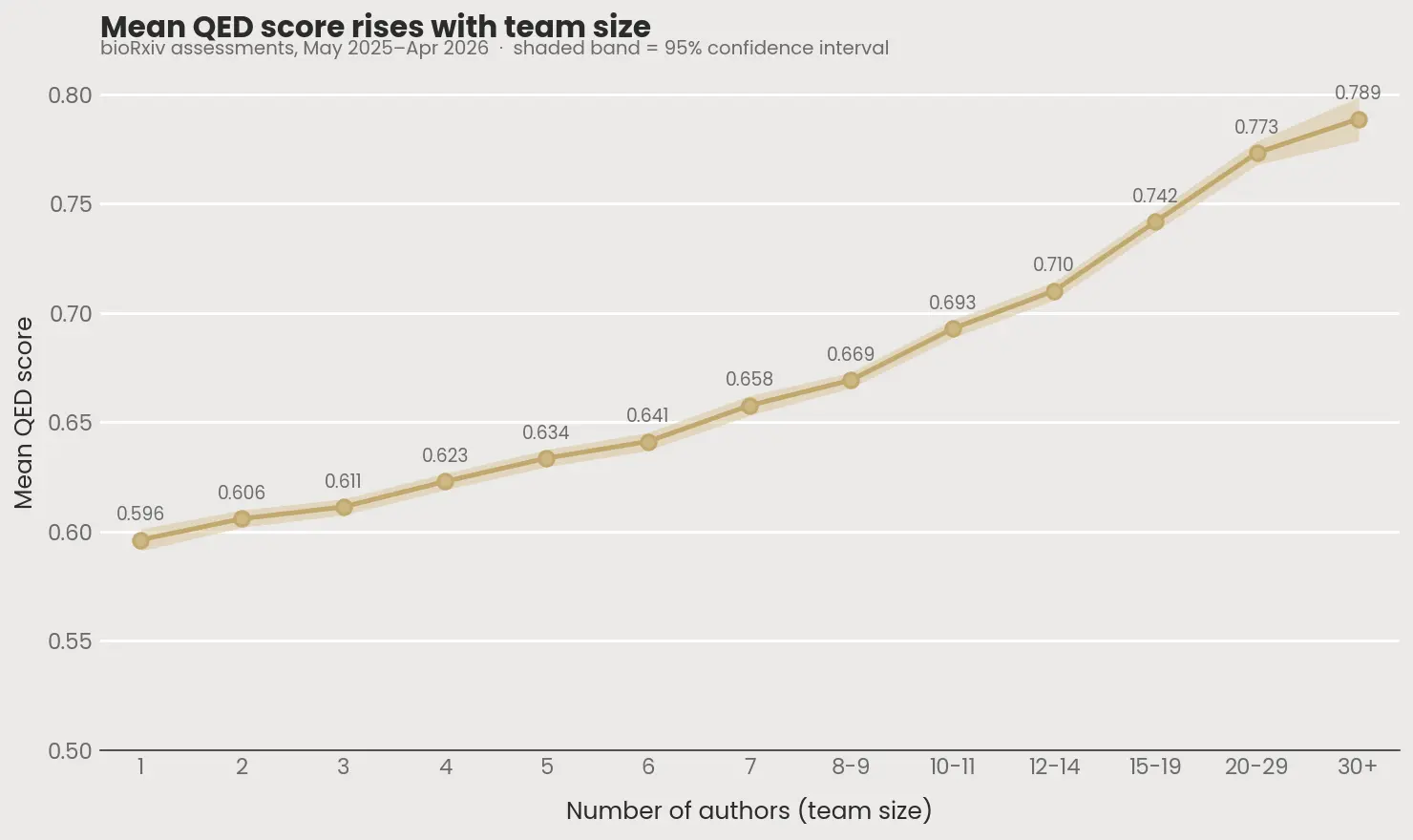
We also found that QED score rises steadily with team size, and not just on average. Every part of the distribution shifts upwards as teams grow. The median QED Score climbs from 60 for papers with 1–2 authors to 76 for papers with 13 or more, while the average follows the same path, rising from 60 to 79, a jump of roughly one full standard deviation. That raises an obvious question: is "international collaboration" just team size in disguise?
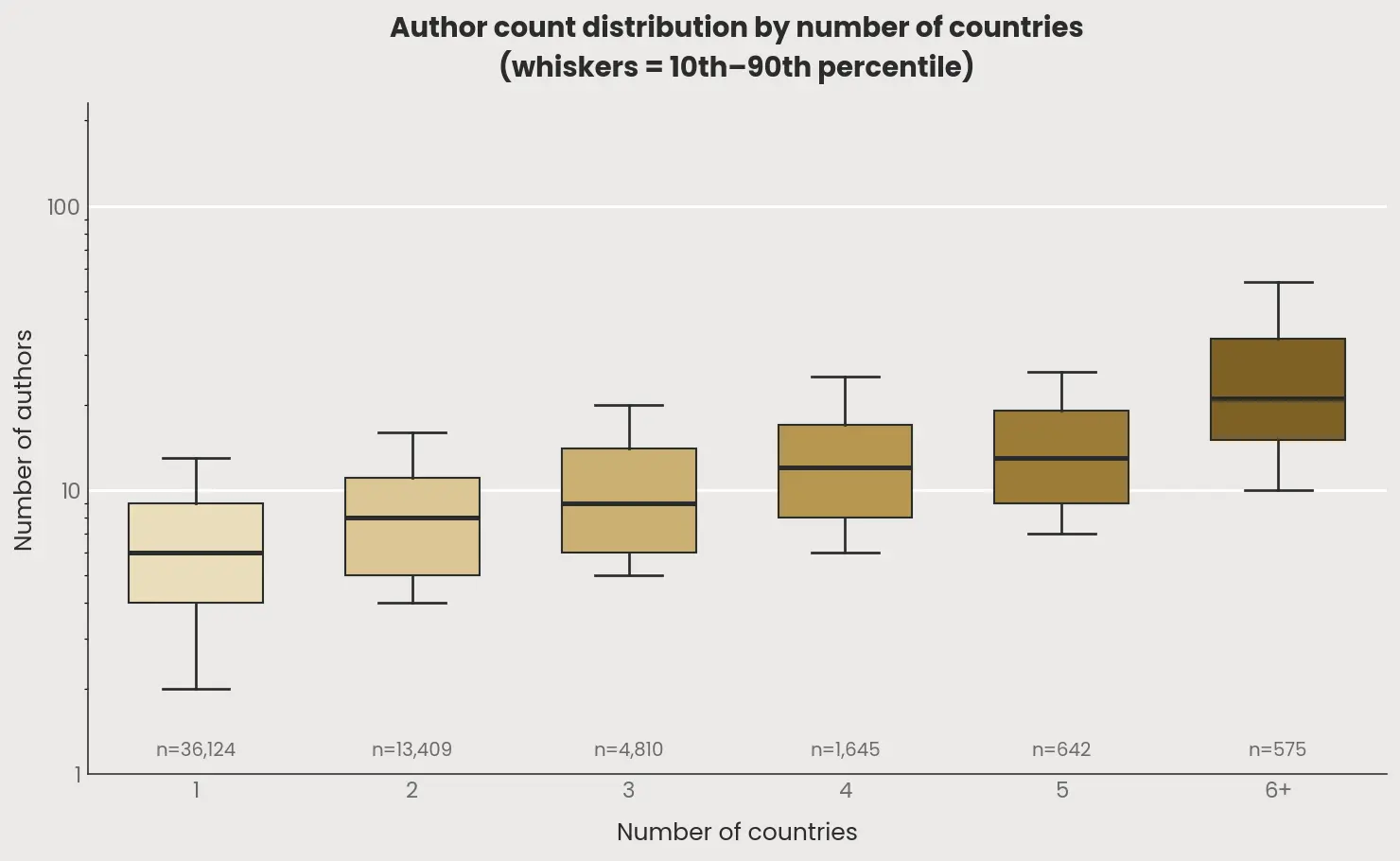
The answer turns out to be, not quite. This is because size and internationality are not separate questions to begin with. Large teams are, to a striking degree, the international ones. Team size climbs with the number of countries on a paper: 2-country papers average ~9 authors, 4-country ~13, and 7+ country papers cross 20. This isn't a coincidence. The specialists, instruments, patient cohorts, and field sites a demanding project needs are scattered across borders, so a team often becomes large precisely by reaching abroad to find them.
Crossing borders isn't the goal, it's the means
However, reaching abroad isn’t free. International collaboration carries its own cost, and it’s a friction no team takes on lightly. Researchers assemble international teams in spite of this cost: whether it’s different time zones, languages, or mismatched institutional policies and rules. They do so because the expertise, instrument, or population they need exists only on the other side of an ocean. And much like the handicap principle in biology, where a signal is trustworthy precisely because it is expensive, that cost is what makes international collaboration a credible signal. A team pays it only when the science requires what lies abroad, so the border-crossing itself becomes a marker of real need rather than convenience.
Team size may be the proximate driver of quality, but going international is frequently the only way to build the large team that delivers that quality.
{{cta-section}}
International collaboration itself raises the odds of exceptional science by 45%
The story so far shows that team size and international collaboration are entangled, but entangled isn't the same as identical. Does internationality still matter once team size is deliberately held constant?
To test this directly, we looked at the odds of reaching the category of highest scoring papers after controlling for both team size and country of origin. Preprints with at least one international collaborator were 45% more likely to reach the top 1% of preprint quality scores than an otherwise-identical domestic paper (OR = 1.45, 95% CI: 1.21–1.74, p < 0.001).
These results show that the advantage holds on its own.
What this means for the policy debate
Our findings land squarely inside an argument already underway. The value of international collaboration and the federal role in supporting work that crosses borders are questions usually argued in terms of funding, security, and administration. The data above gives that argument a measurable dimension that until now has been missing. The international teams now under scrutiny are disproportionately the ones producing the field's best work.
Crossing borders isn't incidental to exceptional science; for many teams, it's the exact way that exceptional science gets made.
researchers
researchers