
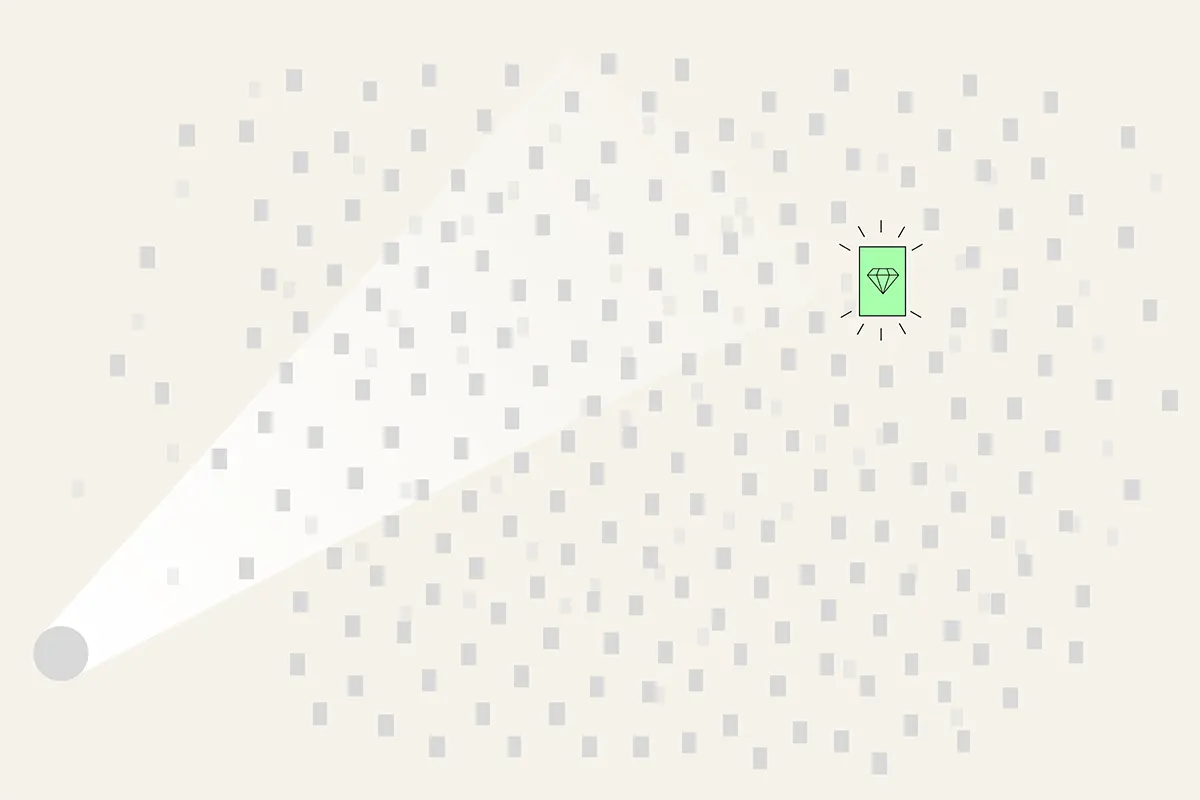


I often think about preprints, and how they are in many ways the gateway to new discoveries. Sitting in life science preprints right now could be the next cancer treatment, a vaccine for a disease we haven't beaten yet, or the mechanism behind a condition that has puzzled scientists for decades.
However, without validation, uncovering this research is like finding a needle in a poisoned haystack. Alongside incredible scientific discoveries are papers that are unproven, manuscripts that are unreliable, and premises which are weak or unoriginal. As the LK-99 superconductor episode showed, even dramatic claims that seem to herald a breakthrough can collapse quickly when others try to replicate them.
The trust gap in scientific discovery
Sifting through and validating preprints is impossible for a lay person. Domain experts spend hours pinpointing weak spots or gaps in papers, and deciding whether the world can rely on their conclusions and results. This makes reviewing preprints impossible to do at scale, and leads to a lag between when the science is written and when it can be trusted enough to utilize. The more outrageous a discovery, the longer it will take to publish, so when a promising pathway or mechanism is uncovered, or a new target is identified, science will evolve while those who need it most wait to find out if it can be acted upon.
The reality of being a researcher in a lab is that you’re never operating at the frontier; you’re always operating on a gap of anywhere from six months to multiple years from the time of discovery.
Building a new layer of scientific trust: The 1%
When we started building our validity machine, the power behind our QED Score and The 1%, we knew we had something special early on.
After validation, we saw that our AI engine could do something human review alone cannot: critically assess every element of a scientific research paper in a standardized way, at scale, and in minutes. A human subject matter expert may bring deep judgment, but they can only review a limited number of papers, and each review inevitably reflects their own perspective, expertise, and capacity. QED Score applies the same rigorous framework across every paper, evaluating originality and validity at a level comparable to a professional reviewer. Researchers remain the innovators and creators. What we provide is the missing layer of trust; not six months to two years from now, but immediately.
For the scientists behind the papers QED Score selected as The 1%, the benefits are obvious. The minute a paper hits the archive the celebration can begin. The tenure application can go out, the grant report can be written, the accolades can start rolling in. This helps labs and universities hold onto the right talent and channel more funding accurately, and means scientists don’t have to wait around for review in order to receive recognition.
However, the same trust layer also allows businesses to draw value from this corpus of information. In life sciences, everything stands on the shoulders of previous discoveries, but when peer review takes so long, those discoveries may as well not exist.
Think about pharmaceutical companies, biotech firms, diagnostics developers, medical device companies, precision medicine teams, and corporate R&D groups. To turn emerging science into new products, therapies, and solutions, these companies are either waiting for papers to be published in journals, or they are attempting to summarize and connect findings on their own systems. While an LLM can digest huge volumes of information, it cannot necessarily tell us whether evidence is trustworthy. Instead, it averages across the literature, without stopping to wonder whether the underlying data is unreliable, outdated, contradicted, or simply wrong.
This weakness is important, because scientific truth doesn’t bend to majority opinion. A field may contain hundreds of papers that support an established view, and then one exceptional new study may overturn that view by identifying a new pathway, mechanism, or explanation. If the model is relying on the weight of the existing literature, the newer discovery may be drowned out by the volume of older papers. Unless the model has been specifically updated or instructed to recognize the new evidence, it may continue to present the old consensus as the truth. Ask an LLM whether a paper is trustworthy, and it may produce an answer that is confident, plausible… and wrong.
For research teams and executives, this can kick off a funnel of poor decisions all based on poor data. As even peer-reviewed papers can become unreliable if they are contradicted by newer work, many teams do not fully trust external literature reviews or generic AI summaries at all. Instead, they rely on their own internal studies, expert review, and validation processes, all of which take significant time and resources.
From individual papers to the whole scientific landscape
Now imagine this new world where the scientist is getting immediate recognition that their work is original and valid, that it can be trusted. The complementary benefit for businesses is that they get answers to the important questions far quicker than ever before, and get access and insight not only into the 1%, but the other 99%, too.
With millions of papers published each year, most businesses have needed to rely on the few that are published with a respected journal, or the small number that they can review internally under time and resource constraints.
With QED Score, businesses can now evaluate far more of the scientific record, much earlier in the research cycle, and with a clearer view of what each paper actually proves. Instead of waiting for a small fraction of studies to pass through traditional review channels, teams can assess the strength, limitations, and evidentiary value of research as it emerges.
This is where the potential of AI begins to show its capabilities. Evaluating one paper at a time is useful. Evaluating a company’s own research corpus is more powerful still. But the true value is unlocked when the same approach can be applied across the whole scientific landscape: For The 1%, it was close to 60,000 papers. But the same technology can be used for a million papers, or eventually for hundreds of millions. At that scale, businesses are using QED Science to go beyond reviewing individual manuscripts, and are starting to map the state of scientific evidence itself.
What this means for life sciences R&D
For a pharmaceutical company evaluating a novel drug target, this means knowing whether the evidence is strong enough to justify the next investment decision. Is the pathway simply associated with disease, or has it been functionally validated? Has the finding been replicated in relevant models? Is this a target worth progressing, or a signal that still needs work?
For biotech teams, it means identifying translational risk earlier. A study may show promise in a mouse model or cell line, but that does not mean it will hold up in humans. By surfacing limitations around models, endpoints, dosing, and mechanism of action, QED Score helps teams decide whether to advance, redesign, or pause before more capital is committed.
For diagnostics, biomarker, and precision medicine companies, it means understanding whether a signal is commercially and clinically robust enough to build on. Has it been validated across cohorts? Does it remain predictive across different patient groups, disease stages, or treatment histories? Is it ready for development, or still exploratory?
The same shift applies to experimental design. Instead of asking, “What does the literature say?”, teams can ask, “What is the weakest link in the evidence chain?” That helps them prioritize the next experiment, close the right gaps, and move faster from interesting science to confident decisions.
A QED Score provides a simple signal, but the deeper value is the analysis behind it. It allows scientists and business leaders to see what a paper does and does not demonstrate, where the gaps sit, and whether a specific finding is strong enough to support the next scientific or commercial decision.
For life sciences companies, that means faster target validation, sharper go/no-go decisions, better-designed experiments, and earlier identification of translational risk. It helps teams decide whether to progress a molecule, expand a biomarker program, redesign a study, investigate an alternative mechanism, or pause before committing further resources.
In a sector where a weak assumption can shape years of R&D, the ability to evaluate scientific evidence earlier, more systematically, and with greater transparency is everything.
A new system for scientific review
The current system for scientific review is collapsing. But the current system is formalized journal peer review, which is only a few decades old at most, hardly set in stone. And it was not designed for a world where hundreds of thousands of papers can appear before journal publication, and where businesses need to understand emerging evidence in real time.
It’s time for a step change in the way that we discover and celebrate exceptional science, and a paradigm shift in how we make this same science available to the businesses and the end customers who need it the most.
We’ve started with preprints but we aren’t stopping there. We’ve uncovered a new way of communicating scientific excellence and putting it to work, and we invite you to get involved.
Learn more about how we validated QED Score in our white paper.