


More than 900 scientists registered for our recent webinar on improving grant proposals before they are put in front of a reviewer, and it's easy to see why.
Getting grant funding is one of the most challenging parts of a scientific career, and the truth is that the difference between a funded proposal and a rejected one often has nothing to do with the quality of the science itself.
For this webinar, we brought together two people who know this better than most: Dr. Angela Andersen, former Cell editor and co-founder of Life Science Editors, who has reviewed and coached scientists through hundreds of grant proposals, and Prof. Barak Rotblat, principal investigator at Ben Gurion University, who has been on both sides of the table, as the scientist and the reviewer. The conversation was hosted by Dr. Lior Onn-Sorek from QED Science.
If you missed the live webinar, you can watch it on demand here, and keep reading for your highlights!
How Can a Scientist Stand Out From the Crowd?
Angela shared how most reviewers aren’t thinking about separating good science from bad. After all, most of what reviewers see is good science. It’s instead about “Why do we want to choose this proposal over a different one?”
Reviewers are looking to answer three questions after reading your review to decide if you are a surer bet than the competition.
- What’s the gap? Here’s where you accurately show what we know, what we don’t, and what the specific gap is.
- Why is it important? Reviewers need to prioritize where to spend money, so make sure to articulate why your science matters.
- Why should it be you? Many labs are studying the same problems, so it's crucial to showcase your expertise, your data and your competencies.
Writing for the Reviewers
Remember that you’re writing for more than one reviewer, and some will be specialists in your field while others are generalists. Angela explained how you can easily lose the generalist by using jargon, getting too in the weeds with dense detail, or being overly nuanced, but on the other end of the spectrum, the specialist who knows your field inside and out will turn off if the language is too superficial or you rely on oversimplified explanations.
To appeal to both of these audiences you need to answer whether the science is new and important, but also whether it’s rigorous and feasible. It’s what Angela called “a tricky needle to thread, appealing to both the generalist and the specialist in one proposal.”
Writing to these multiple audiences means starting with good grantsmanship. Angela described the bare minimum as consistent formatting, clear paragraphs, plenty of white space, fluent prose and good grammar so the document is easy to skim. Standing out from the crowd means taking it to the next level, providing reviewers with a reason to believe you’re going to generate results. Top tips from Angela include:
- Have a clear narrative: Include what we already know and what we don’t, why it’s important, why we don’t already know this, and then why your lab is the one to solve it. This should feel like a clear story where one answer leads to the next.
- Provide a critical analysis: Angela’s advice here is really powerful; “be collegial, constructive and thorough in your review of the literature.” This includes citing all relevant scientists including competitors, and being constructive when raising limitations.
- Don’t overcomplicate or oversimplify: The real challenge is getting everything you need into a single page or page and a half while making sure you give a thorough review of the field.
How Risk and Mitigation Strategies Can Inspire Trust
One interesting area that Angela described is how scientists handle risk. Angela spoke about how at LSE she frequently sees people give superficial explanations where they dismiss the idea of risk, which is unsatisfying to a reviewer who does want to hear how you would handle potential pitfalls.
Angela explained clearly that “Science is not a straight line.” If you write your risk and mitigation strategies that way, you look naive. You don’t want to undermine your proposal, but you do want to show that you’re scrutinizing your own work.
Ask yourself, conceptually — what if the data doesn’t support the hypothesis, does something useful emerge? Technically, what orthogonal approaches can you consider if there are limitations of your methods? And finally, in terms of expertise, what are the limitations of your group and how can you close those gaps? For each pitfall, consider its nature, why it’s unlikely, and the alternative strategy you would use.
Using AI to Strengthen Grant Proposals
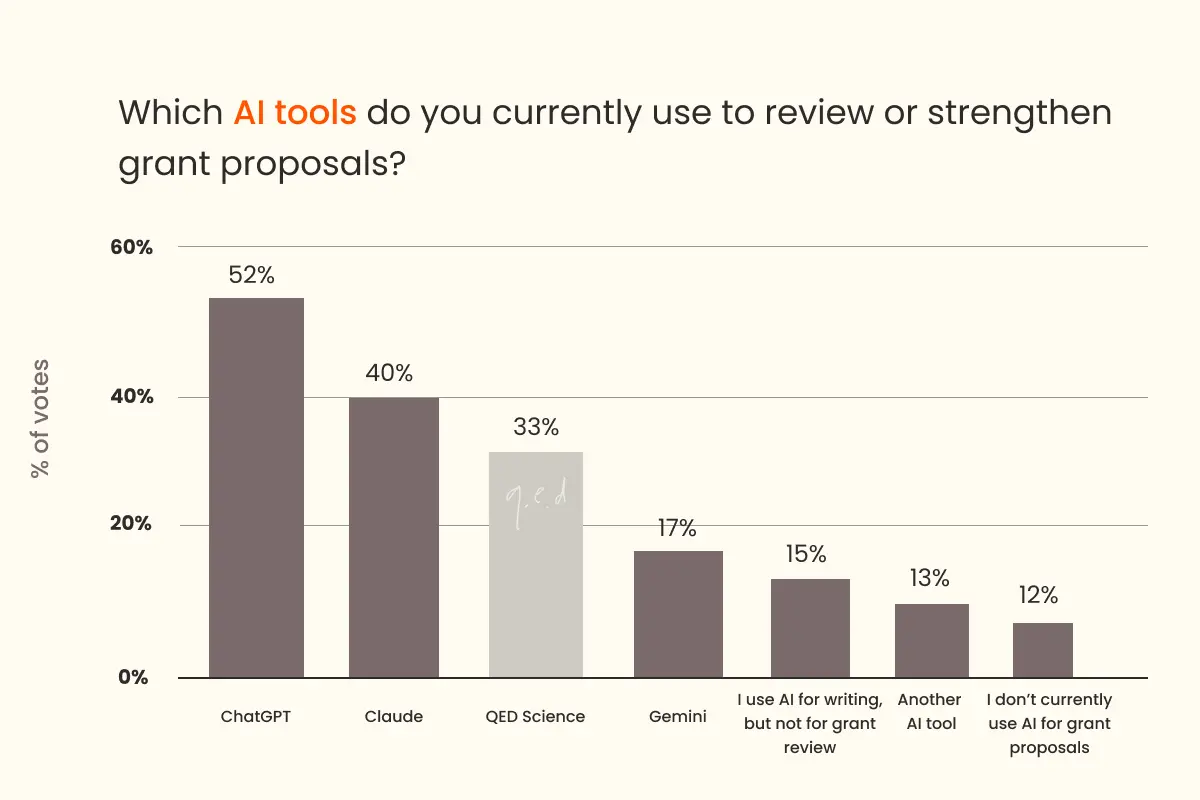
In today’s AI-fueled scientific field, we spoke to our panelists and our audience about how AI tools fit into the grant proposal picture. We found 88% of participants are already using AI solutions for grant review, including ChatGPT and Claude, and it was great to see that more than a third of our audience that use AI tools are leaning on QED Science.
Barak shared his three best practices for using AI for grant review, discussing the process of uploading your proposal to an AI tool, and asking questions to stress test the document and get some objective feedback.
Remember, if the AI didn’t “get it”, the reviewer won’t either
It’s easy to call the AI tool an idiot and say the problem is with the technology. And of course reviewers are smart and capable and experienced in your field. But it’s worth taking a breath, re-reading what you wrote, and trying to be objective about whether you’ve explained the problem well enough.
AI can surface blind spots
You know your proposal so well, it’s possible that your brain is closing gaps which you haven’t described clearly. AI is good at pointing out those missing steps, showing you that a conclusion is not as obvious as you may have originally thought.
Not all AI advice is equal
Don’t lose the “soul” of your grant proposal by following every piece of advice an LLM or a tool like QED Science provides. AI is very smart, but you know the voice of your grant best, and the final decision should be owned by you.
Using AI to Stress Test the Science Before Reviewers Do
We’ve already seen that scientists are overwhelmingly using AI, but what impact are they experiencing? 70% say that AI accelerates the writing process, and 53% use it to get additional objective feedback. Additional benefits include adding confidence and an extra layer of thoroughness and rigor when working on a proposal.
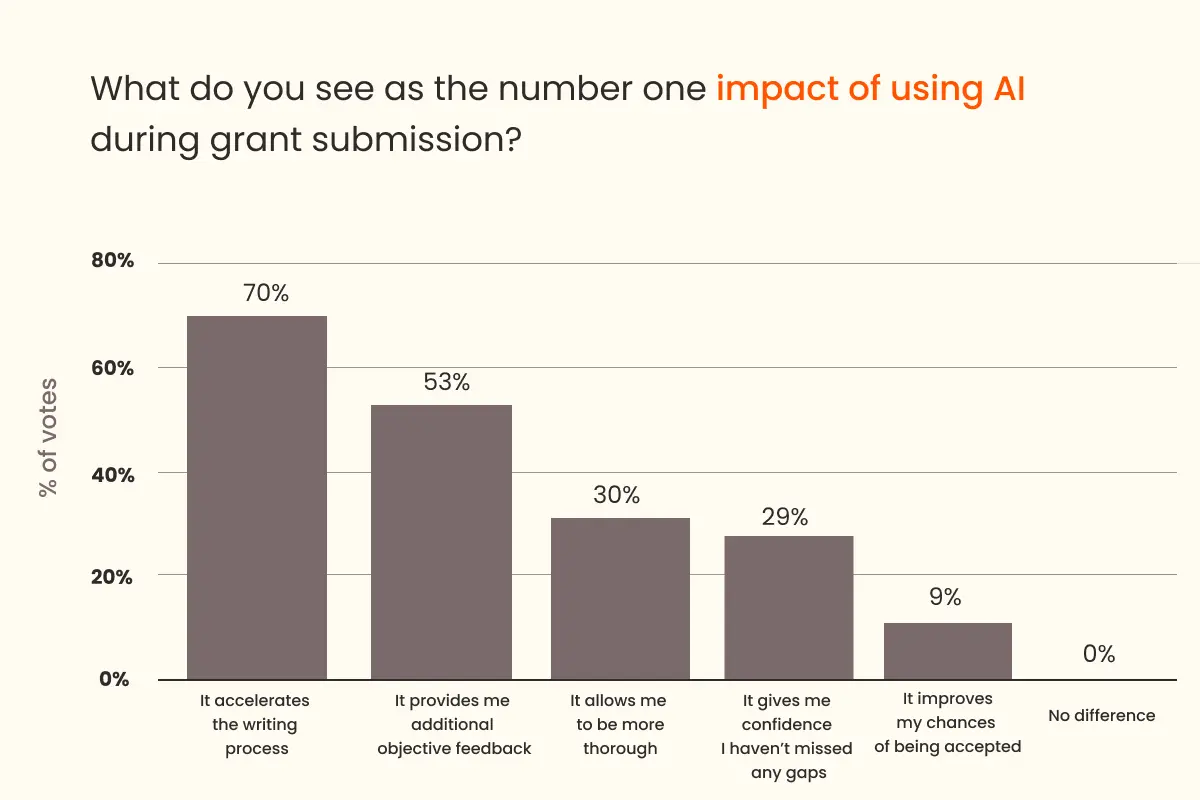
Ultimately, your goal is to guide the reviewer to understand your hypothesis, and used well, it’s clear that AI is becoming that trusted colleague which helps you get there with confidence.
This webinar was so full of value, we’ve only just scratched the surface! Watch the full event on-demand to uncover:
- Practical examples of how to display your data in a way that speaks to the specialist and the generalist reviewer, from figures to statistics.
- Angela’s hands-on exercises for stress-testing your proposal before you hit send, and being judicious about soliciting and receiving feedback from multiple sources.
- Barak’s specific AI prompts to help stress-test your proposal before you send it for review.
- A live demo of QED Science, and how to use the Grant Review Tool to improve a grant proposal.
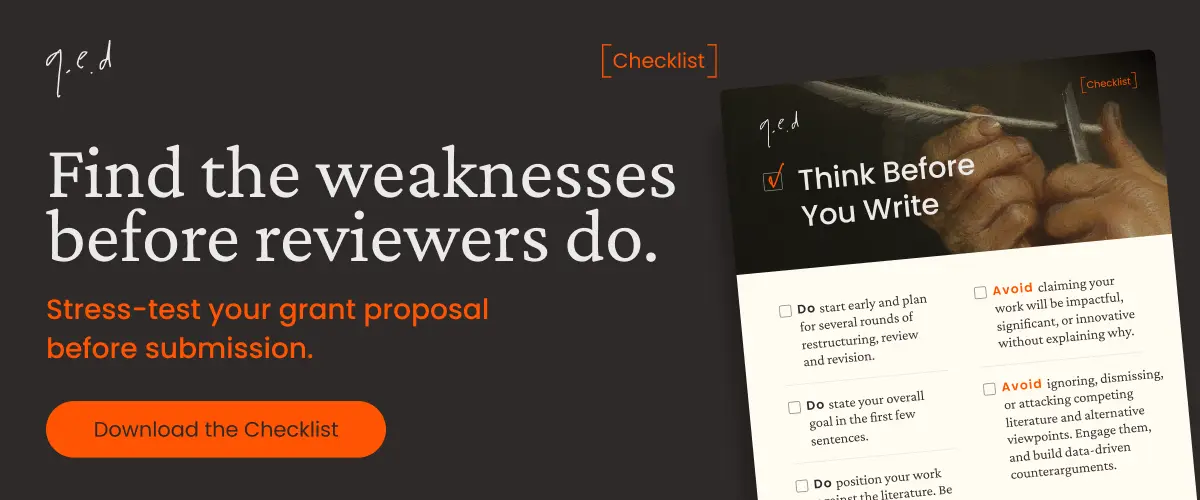
And don’t forget to download your takeaway from the event, a practical checklist with best practice dos and don’ts for getting your grant ready for the review board, written by Dr Angela Andersen and Prof. Barak Rotblat. Download it here.
researchers
researchers