


Peer review has always been slow, and the literature has always outpaced any one scientist's ability to read it. Advances in AI promised to help, but for many researchers they've delivered new problems: fluent summaries with fabricated citations, generic feedback that doesn't engage with the actual claims in a paper, and search results that require exactly the right prompt to be useful.
For Dr. Sauvik Das Gupta, a biomechanist who studies human locomotion, these challenges were just part of a day’s work, until he stumbled upon QED Science by accident, after uploading a preprint to BioRxiv.
Sauvik’s research looks at how healthy gait changes across the lifespan, and how well treadmill-based studies actually reflect real-world, overground movement. He holds a joint PhD in Human Movement Sciences and Biomedical Sciences from the Vrije Universiteit Amsterdam in The Netherlands and KU Leuven in Belgium, and is currently a postdoctoral researcher at AIST in Japan, where his work focuses on the energetics and neuromuscular control of walking in older versus younger adults.
“After uploading my paper to BioRxiv, I was offered an analysis of my preprint by this third party tool I had never heard of, and I was immediately excited,” said Sauvik. “Theoretically at least, BioRxiv is meant to be built for community feedback, but realistically it’s just a cloud platform that makes work available and citable. One of my goals was to get some comments and feedback aside from what my colleagues could provide, and this looked like a great opportunity for that.”
“QED Science’s Paper Review highlights the advancements which come from my work”
After uploading his paper, Sauvik found he could immediately see an overview of all the aspects found in his work. To start with, viewing the aspects already known was useful. “This immediately shows me that the paper isn’t an outlier,” said Sauvik. “It goes according to the broader consensus according to the published papers in the field.”
Next, he could look at new aspects, which included how the metabolic penalty of treadmill walking also affects healthy young adults across multiple speeds, the divergent behavior of gross and net metabolic costs, and the link between treadmill-induced metabolic penalty to increased stabilization demands. “This highlights the advancements for the field which come from my work. It was real validation of the research we had created.”
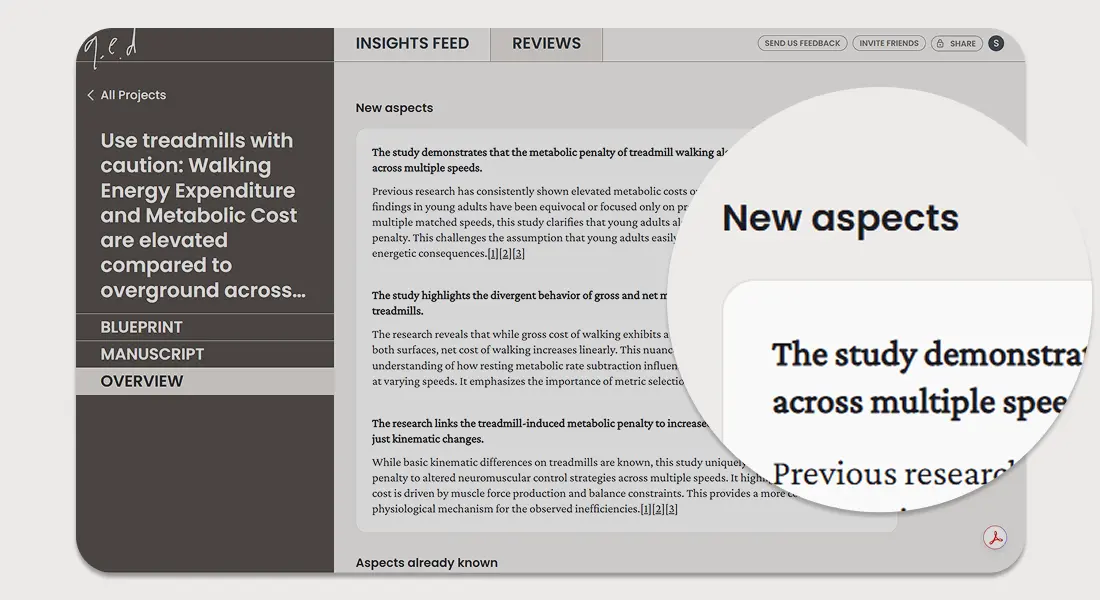
“It feels like an active conversation”
Next, Sauvik was able to dive into the claims individually, and uncover any gaps, clearly marked within a thorough claims tree. “This was a huge uplift from what I could get using BioRxiv” said Sauvik. “This felt like an active conversation where I could hear reviewer feedback and delve into the gaps uncovered and whether I felt like they needed addressing. It was great feedback to make my paper better in the time between uploading the preprint and submitting to a journal.”
Sauvik was able to look at each gap in detail and ask the questions he'd normally save for a lab meeting: is this a good gap, or a superficial one? Does it actually threaten the claim, or is it a minor caveat? Does it need addressing now, or is it something to flag for future work? Rather than surfacing every possible critique, the claims tree let him triage, spending his attention on the gaps that mattered and moving past the ones that didn't.
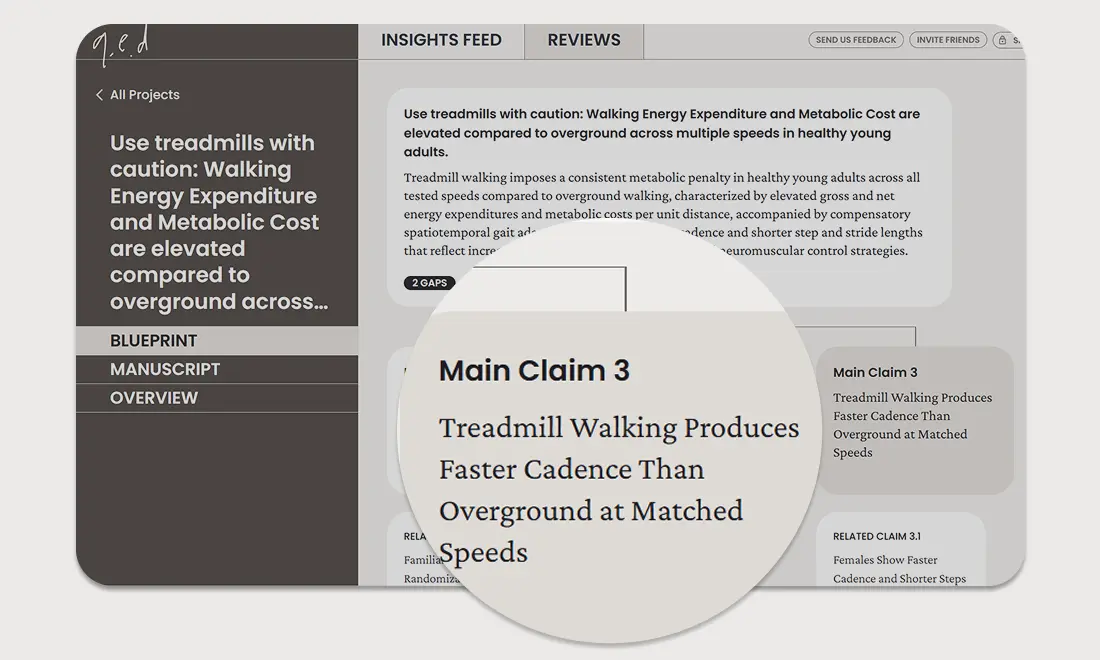
“QED builds a bridge between new literature and my own research”
As well as manuscript review, Sauvik has become a regular user of the QED Science Insights Feed, which offers a tailored list of relevant and curated papers to ensure he stays up to date with the literature.
“Previously, I would use Google search or LLMs to find relevant literature, but with the Insights Feed that’s automated for me, without the need to finesse the perfect search term or prompt,” Sauvik said. “I use the ‘why you should care’ feature to get a quick summary of each paper, and it even builds a bridge to my own work for me so I can see why it matters for my own research. It’s exciting, and very helpful. I often read the ‘Why You Should Care’ before I even read the abstract! I use it as one of the determinant tools as to whether I should read the whole paper.”
“Building a library for further systematic review or meta-analysis”
With this easy overview, scientists can decide which papers to read closely, and which to skip or save for later. This simple user interface not only helps readers to focus in on what matters, but it also supports wider goals such as building out a research library of relevant content, something else that Sauvik now uses the Feed for.
“Traditionally, I would sit with co-authors, supervisors, or a medical librarian in our field who had good knowledge of the literature,” said Sauvik. “They would help with search techniques to build a library, but with the Insights Feed I can do that independently in a lot less time.”
The feedback widget, where users can numerically and qualitatively provide guidance on which papers are relevant and which are not also supports this kind of value add, helping the Insights Feed improve over time and provide better recommendations. “My top tags to provide feedback with are the methodological approach, mechanistic pathway, and the biological question. By interacting with the widget, over just a few weeks, I’ve noticed my recommendations aligning better with my daily work.”
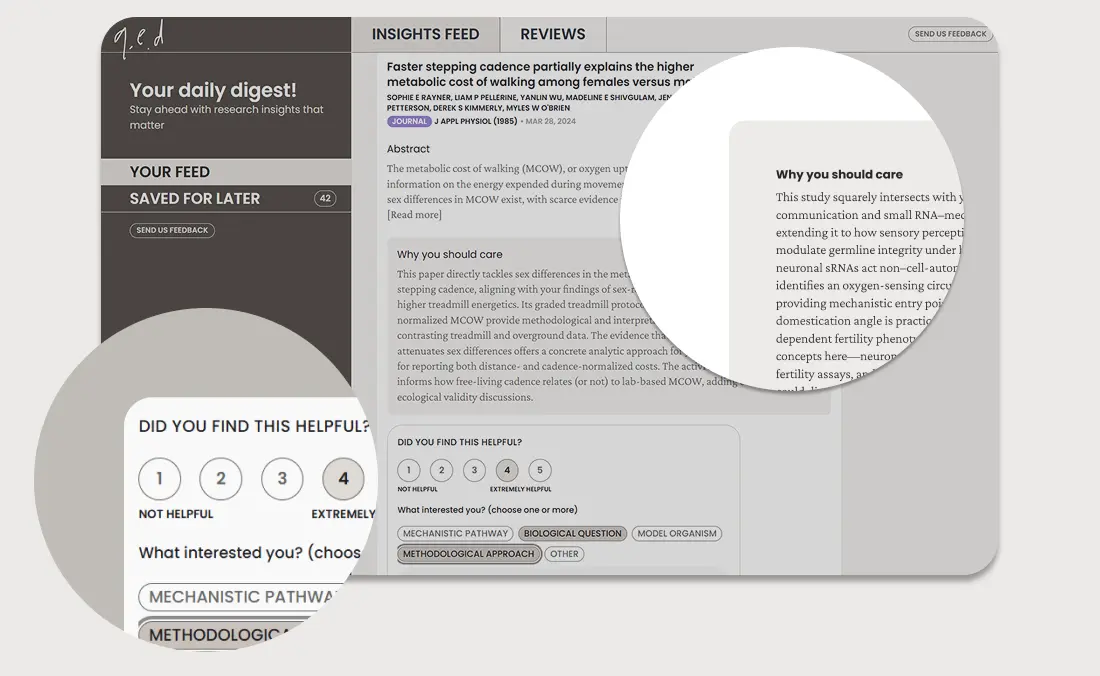
“A more contemporary picture of how the field is developing”
One real challenge for scientists is that journals often take months or even years to publish research, which means you’re generally working without the latest literature to hand. The QED Insights Feed offers papers from journals, preprints, and even conference talks or abstracts.
“Preprints give you a more contemporary picture of how the field is developing, and with the Insights Feed you can see that in parallel to how you’re developing your work,” said Sauvik. “This is something I hardly got from AI or from Google, because they mostly give papers, and journals are quite slow.”
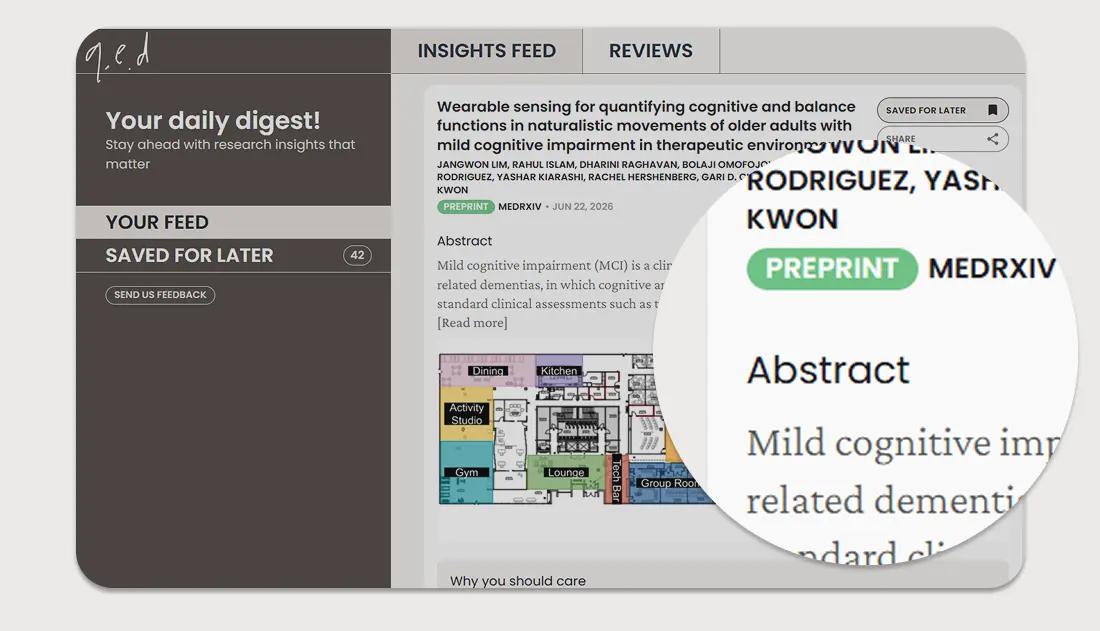
For Sauvik, what started as a curious click on a third-party tool from a BioRxiv upload has become part of his everyday research workflow. From surfacing gaps in his own manuscripts to keeping him ahead of a fast-moving literature, QED Science has given him something he'd previously had to piece together from colleagues, supervisors, and slow-moving journals: a fast, independent, and continuously updated read on where his field, and his own work stands.
Interested in using AI to sharpen your own research and literature review? Try Paper Review for your own manuscript here.
researchers
researchers