
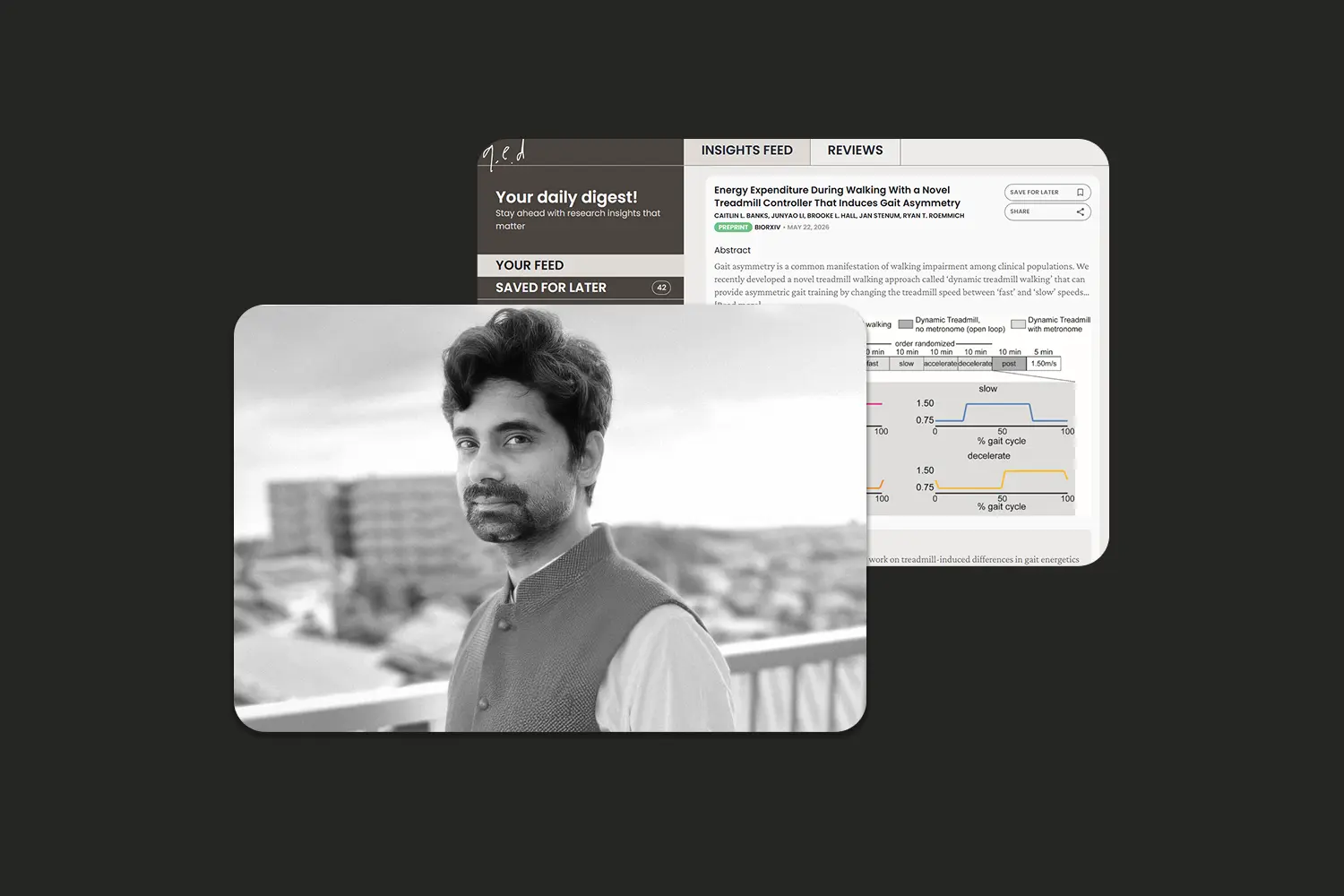

It’s 8.47am and I’m getting ready to start my day, to open my inbox and see what my team has waiting for me.
In Japan, my field is called biomechanics, but in Belgium and The Netherlands where I did my PhD you may hear it called human movement sciences, and in North America it could be kinesiology. Whatever nomenclature you use, working as a post-doc researcher at the National Institute of Advanced Industrial Science and Technology (AIST) in Tokyo, my group looks specifically at why we walk the way we do when we are healthy and young and why this changes as we age, as well the ecological validity of walking experiments, mainly completed on treadmills, while humans of course are used to walking in various terrains.
As in any scientific field, it’s crucial to stay up to date with the literature and make sure we have a thorough view into the research. Something we read today could inform a decision we need to make tomorrow. Traditionally my process for this was a simple Google search, and in the last few years I’ve augmented that by using Microsoft Copilot. I won’t lie, it’s a manual process of searching, prompting, refining, and wondering what I’ve missed. And the amount of literature out there is daunting to say the least.
More recently, I’ve come across the QED Science Insights Feed, which I open now before the clock hits 9am and I have to finish my coffee and get started with the day. As soon as I open the feed, I see a curated list of papers, preprints, and even conference literature, automatically chosen based on my specialties, my research, and one of my papers from my postdoc career, which I uploaded a few months’ previously, Use Treadmills with Caution: Walking Energy Expenditure and Metabolic Cost are elevated compared to overground across multiple speeds in healthy young adults. Not having to search or consider my prompts makes a huge difference, just knowing that these recommended papers are here waiting for me automatically.
The first paper I see is from a journal, titled "Faster stepping cadence partially explains the higher metabolic cost of walking among females versus males."
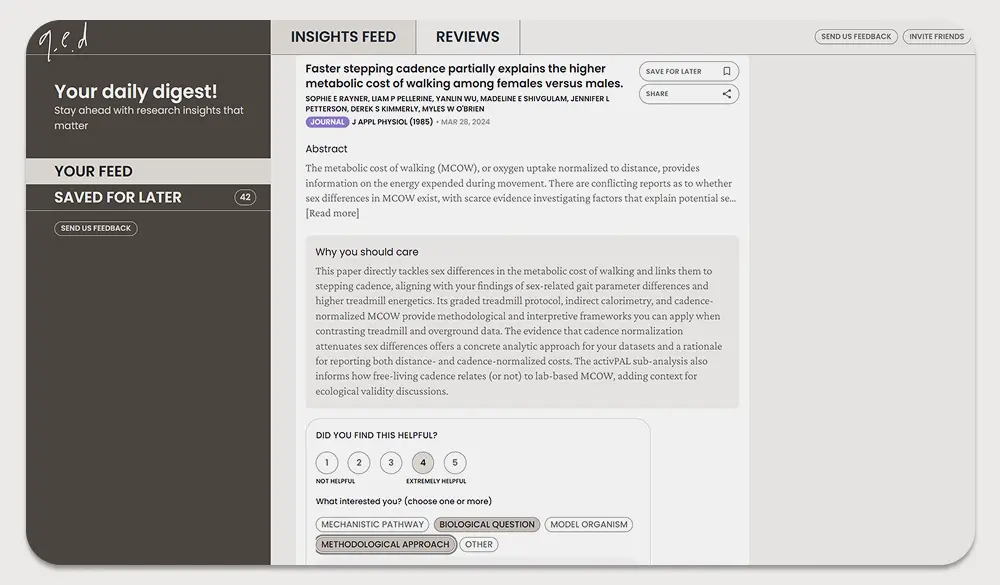
Before I even open the abstract, my eyes travel down to the “Why you should care” section. This has become invaluable to me, building a bridge between the literature available in front of me and my own specific research and field. I can see that this paper aligns with our own findings of sex-related gait parameter differences and higher treadmill energetics, and so knowing they will find it interesting and relevant, I immediately share this with my group.
The next item on my Insights Feed is not from a journal; it has the green Preprints tag that tells me this is recent research which has not yet been published. Another important differentiator over using Copilot or any other LLM, the Insights Feed pulls literature from a much more comprehensive range of sources, including conference literature and preprints. The title is "Energy Expenditure During Walking With a Novel Treadmill Controller That Induces Gait Asymmetry", and I can see by looking at the embedded figure in the overview a crucial diagram that distinguishes normal walking from a dynamic treadmill with and without a metronome.
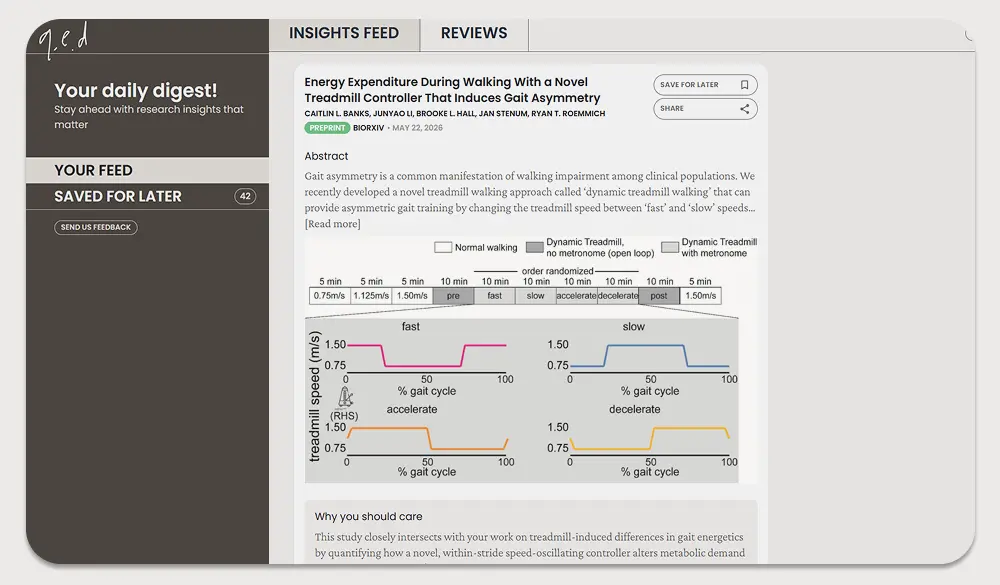
Immediately I can see that this closely intersects with our work on treadmill-induced differences in gait energetics, and I agree strongly with the ever-helpful “why you should care” analysis that this could inform our future studies in bridging healthy and clinical populations. This paper is a great candidate for our journal clubs, where we get together as a group, including biomechanists, physical therapists and sometimes psychologists and discuss the latest research.
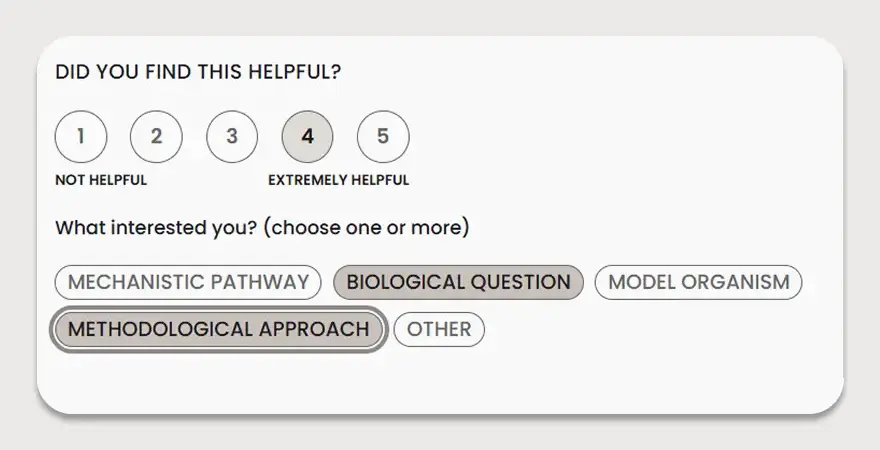
The next two papers on the feed feel less relevant to me, and I use the “Did you find this helpful” widget to provide my feedback. I’ve noticed that over the past few weeks of using the tool, the more I interact and provide this feedback, the better my recommendations have become. I provide a number between 1-5 of how useful the recommendation was, and I use the tags to explain more qualitatively what made the difference for me, including biological question, methodological approach, and mechanistic pathway.
Checking my watch, it’s 8.56am, and I have a few more minutes of peace. I scroll to the next recommendation, which is titled "Wearable sensing for quantifying cognitive and balance functions in naturalistic movements of older adults with mild cognitive impairment in therapeutic environments". Interesting. This one needs more time than I have right now. It connects directly to the human augmentation work I'm building toward.
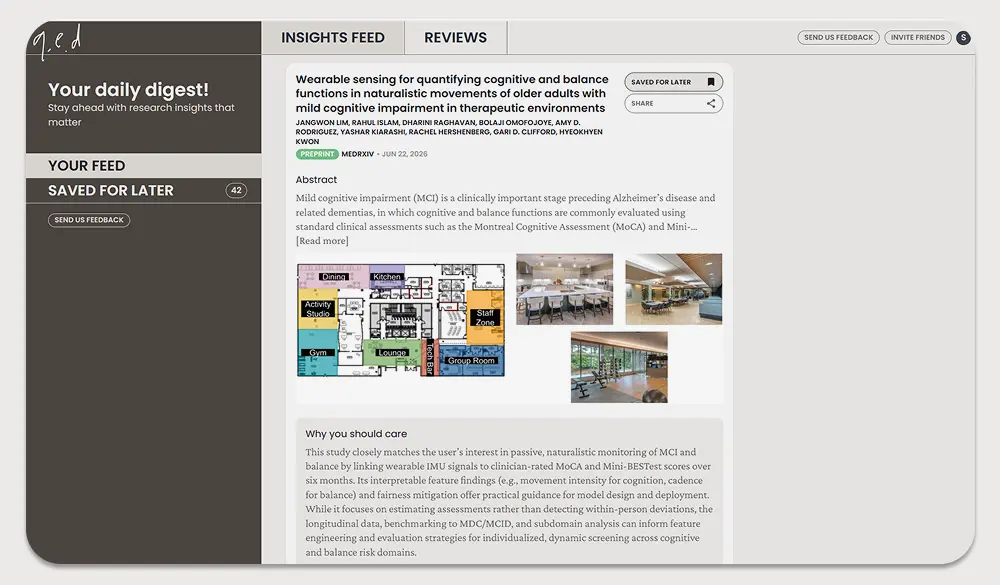
This paper approaches a related problem from a different angle: instead of augmenting movement directly, it uses wearable sensing to passively track cognitive and balance function in older adults with MCI, in a real therapeutic environment rather than a lab.
That's useful to me for a few reasons. First, it's a translational example of taking wearables out of controlled settings and into naturalistic, everyday contexts, which is exactly the direction I want my own exoskeleton or assistive devices work to go. Second, the way they link movement features (like cadence and movement intensity) to clinical outcome measures gives me a possible framework for how I might validate whether an assistive device is actually helping someone move better and feel less fatigued, not just changing their gait mechanically. It's less about the exoskeleton itself and more about how to measure and evaluate benefit in real-world use, which is something I'll need for my own design work down the line. I use the “save for later” function, which is fast becoming a way to curate my own personal library, a way to use others’ research to better design my own.
As I close the Insights Feed and head to my email inbox, I feel like I’ve already started the day with a win. I’ve sent an interesting journal article on sex-related gait parameter differences to my team, identified a potential preprint to discuss at the next journal club, and added a highly-relevant paper to my personal library of literature, ready to dive into at a later date. By giving feedback directly to QED Science, I also know that tomorrow’s Feed will be even more sensitively tailored to what I need to read to stay on top of my field.
A few months ago, staying current meant prompting Copilot, or an open-ended Google search where I couldn’t be sure the results were relevant or accurate. Now, it’s a handful of curated recommendations on a Feed that gets sharper every day I use it. The literature hasn’t reduced, it’s still overwhelming to think about everything out there, but I’m no longer chasing it down. My reading list finally feels like it’s keeping pace.
researchers
researchers