


Keeping up with the literature often relies on finessing the right AI prompt, choosing the perfect Google search term, or sifting through a huge amount of content delivered by the latest research tool. But how can you be sure the content you find is both relevant to your research and high quality?
This is exactly the mission of QED Science’s Insights Feed, expanding the QED suite of solutions from supporting researchers in interrogating and validating their science on demand, to continuously surfacing the science that matters to their work.
QED Science scans millions of scientific articles and draws on multiple additional sources to identify relevant and high quality work across more than 250 life-science subfields, from molecular and structural biology to neuroscience, evolution, and ecology. For an academic researcher, this allows you to surface the one new paper that directly closes a gap identified in your own work, alerts you to when another group publishes closely related work, and helps you to identify researchers or labs publishing complementary work who could become your next collaboration.
As important scientific information does not only appear in published papers, the Insights Feed pulls content from preprints and conference abstracts, ranking this literature against your own research profile and offering it all within the same discovery experience, updated daily. This helps you follow developments beyond the conferences you can personally attend and beyond the publications you already know to monitor.
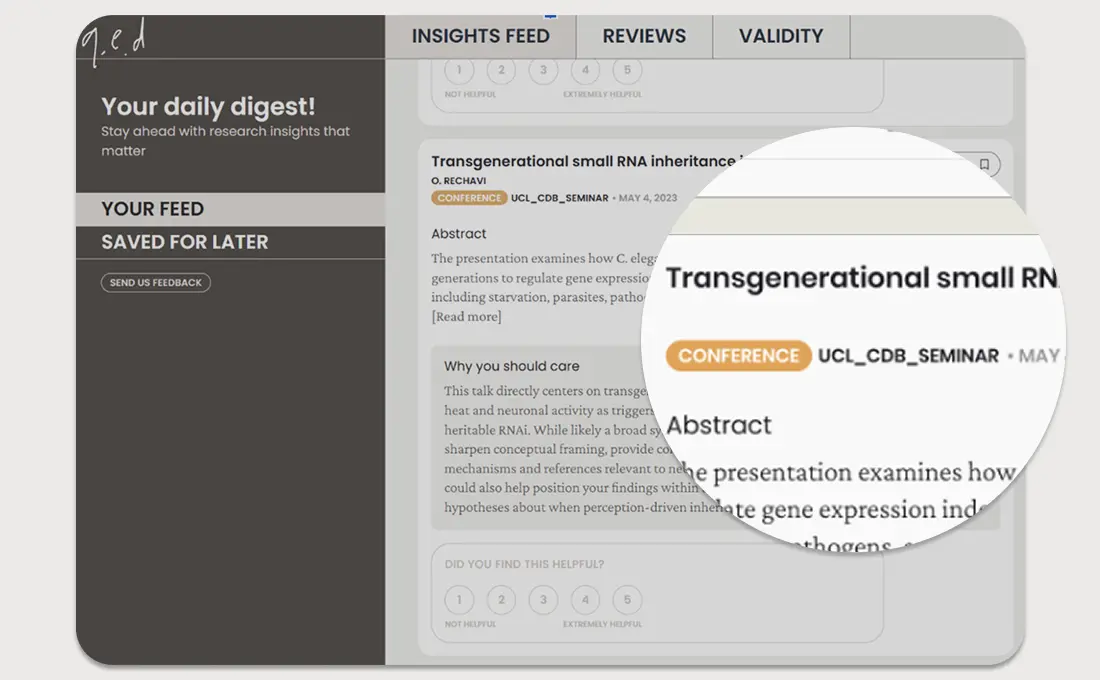
While PubMed or Google Scholar may provide a chronological list or lean on generic keyword matching, and LinkedIn, X, or Bluesky offers whatever happens to surface on your timeline, QED Insights Feed learns from your research profile and identifies what matters to you.
Unlike agentic research workflows that generate an overwhelming amount of output, Insights Feed parses the scientific signal and handles the filtering, prioritization, and scientific evaluation upfront, determining what is truly useful to each reader. By providing a clean, continually updated feed of the science relevant to their work, researchers can stay current, and understand what has changed in their field.
Recommendations can be informed by your published work, research interests, and materials you choose to upload, including manuscripts and proposals. This helps the system distinguish between science that is broadly interesting and science that is specifically relevant. As you engage with the Insights Feed over time, providing qualitative, quantitative and free-text feedback on your suggested literature, the recommendations will more closely align with what you would like to see.
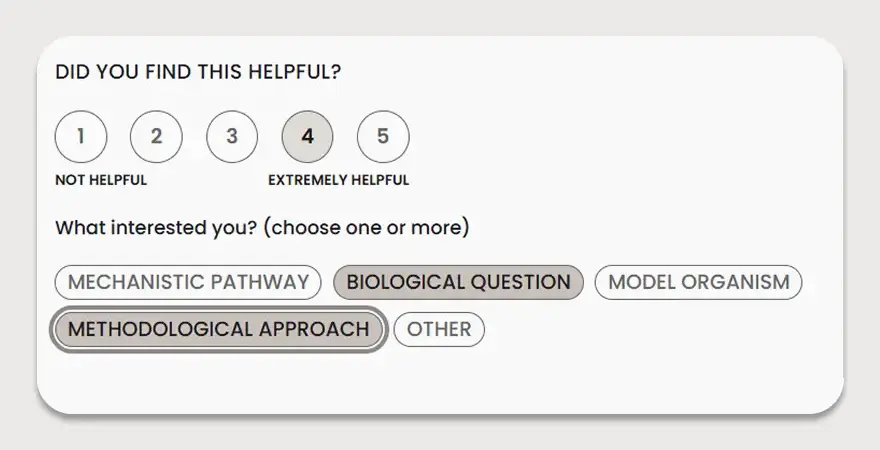
Recommendations are generated without human review of uploaded research materials, helping preserve the confidentiality of unpublished work.
The result is so much more than a list of literature from your field. It is a curated library ranked around your own research context, with recommendations selected for relevance, quality, and diversity.
Discovery that ensures literature is relevant to you
As scientists ourselves, we know that researchers often care about very specific details.
A paper may appear unrelated to your field while containing a method that could change how you run an experiment. A conference abstract may contain an early result that will not appear in a journal for another year. A single claim in a paper from a neighboring discipline may be more useful to you than the rest of the publication as a whole. QED Science analyzes papers in the context of your research, allowing it to recommend work based on a specific result, method, or finding even when the paper as a whole might not seem relevant.
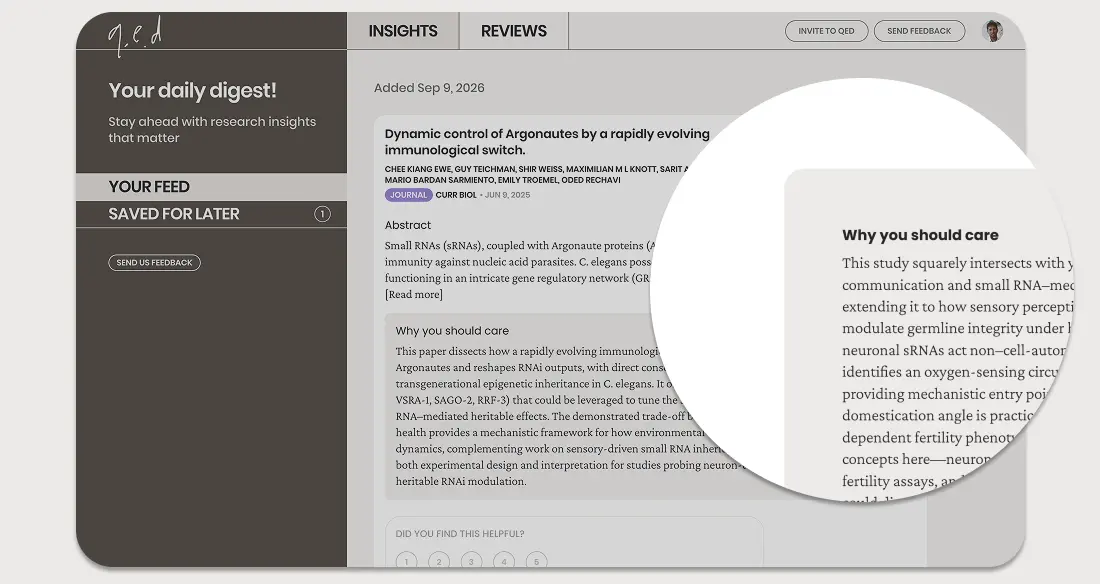
In the example below, a researcher studying neuron-to-germline communication is shown a paper whose main finding concerns fertility under heat stress. The bite-sized “Why you should care” summary explains its relevance: the study shows that small RNAs produced in neurons can act on the germline from a distance and identifies an oxygen-sensing circuit that influences this signaling. These findings give the researcher concrete mechanistic starting points for exploring how an animal’s sensory experiences can influence its germline. Because the paper focuses on heat stress, it might otherwise have been overlooked.
Why relevance alone is not enough
Just as importantly, QED Insights Feed answers a second question above relevance: not only “Is this applicable to me and my work?” but for select preprints, also “Is this worth my time?”
Many papers are relevant, but you still have to decide whether its conclusions are credible, whether the work is original, and whether it deserves a deeper read. The Insights Feed is built on the backbone of QED Science’s scientific judgment engine, which means for select preprints we can filter for quality and provide a structured signal of that quality using our QED Score.
The process works as follows:
- Each paper is anonymized to remove prestige signals, such as journal names and institutional affiliations.
- The paper is broken down into its core claims so that each can be evaluated individually.
- Each paper receives a standardized score based on an assessment of its claims.
Below, you can see a preprint which is marked as a top selection by QED Score.
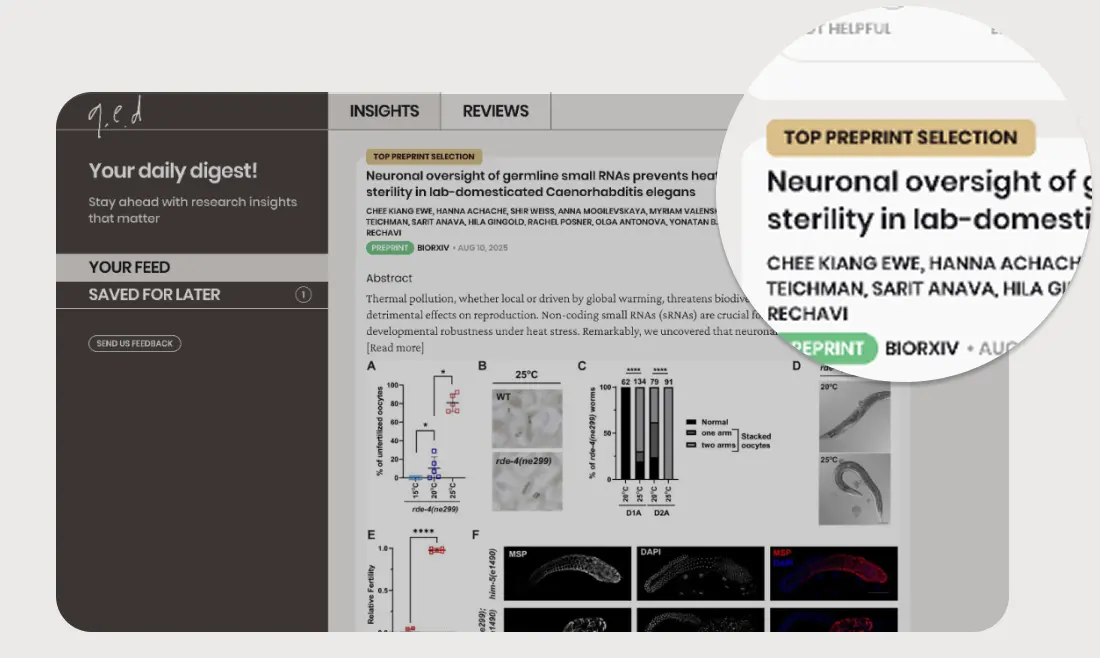
When these preprints are surfaced in your daily feed, by checking its QED Score and the “Why you should care” summary, you can now make two decisions quickly: whether a preprint is relevant enough to investigate, and whether the underlying work appears strong enough to justify your attention.
From information overload to scientific signal
Today, more than 10,000 labs use QED Science to interrogate and validate science on demand. Insights Feed extends that into a continuous view of the science relevant to each researcher's work. It applies personalized discovery across papers, preprints and conference material before anything reaches the researcher. That helps researchers stay current within their fields and surfaces useful work from outside the areas they would normally search.
The goal of the Insights Feed is simple: less noise, less effort, and better access to high-quality science. It’s neither an unfiltered stream of papers to scroll through nor a multi-step workflow that generates more output while leaving the evaluation to you. Instead, the Insights Feed handles the filtering, prioritization, and scientific evaluation upfront. It gives you a clear, continuously updated view of new developments in your field, highlights the research worth your attention, and surfaces findings that could inform your next experiment, grant proposal, or research decision.
FAQs
researchers
researchers